Contradanza Salon – History
The contradanza was the first European dance that truly became Cuban: under African influence it grew into something of its own. It is the starting point of the Cuban salon dance lineage that would eventually produce danzón, mambo, and cha-cha-chá.
What Made It Cuban
Even in its earliest Cuban form, the contradanza was already different from its European source. Cuban musicians gave it the habanera rhythm: a bass pattern with a dotted first note (DAAM-da-DUM-DUM), closely related to the tresillo (long-long-short, 3+3+2) that also sounds in Afro-Cuban music. It gave the music its characteristic, gently swaying feel. The rhythm became so associated with Cuban music that it traveled the world: you can hear it in Bizet's Carmen, in early tango, and in countless 19th-century popular songs.
This was African influence at work: not explicit, not acknowledged by the salon class, but present in the bones of the rhythm. That is less strange than it seems: the musicians who played at the balls were largely Black and mulatto musicians. Music was considered a trade for the lower classes, and through their hands the African rhythmic feel entered the salon.
Listen
Contradanzas were mostly written for piano, but in the ballroom an orchestra played them. The last tab shows what Irakere made of one a century and a half later.
Saumell dedicated this piece to the Italian soprano Fortunata Tedesco. Played by pianist Yamira Rodríguez.
One of Saumell's best-known contradanzas, from the 1850s. Played by Amaury Morales.
A contradanza as it sounded in the salons, by the orchestra of Odilio Urfé.
Irakere plays Saumell's Los ojos de Pepa: salon music from 1850 in the hands of Chucho Valdés's band.
The Dance
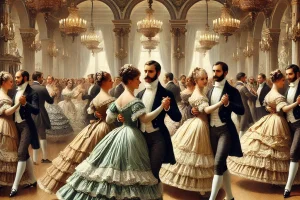
Contradanza was a group figure dance: formal, indoor, with couples in rows or a square and a bastonero (dance leader) calling the figures. It was a social activity for Cuba's literate class: plantation owners, merchants, professionals, and their families.
Despite that formality, Cuban dancing was already looser in the hips and more rhythmic than European ballroom. More about the steps and figures is on the dance page, about the music on the music page.
Key Composers
- Manuel Saumell (1817–1870): the father of Cuban contradanza as an art form; his piano contradanzas established the genre's musical language
- Ignacio Cervantes (1847–1905): refined the form and bridged it to the danza
- Miguel Faílde (1852–1921): worked in the contradanza and danza world before composing the first danzón in 1879
Origins
The contradanza travelled a long way before it reached Cuba:
- England (17th century): the country dance was a village dance in rows, with couples facing each other. John Playford recorded its figures in The English Dancing Master (1651); after that it became popular at court too.
- France (late 17th century): at the court of Louis XIV, country dance was Frenchified into contredanse, as if it meant "facing dance". The French turned it into a refined salon dance that conquered all of Europe.
- Spain (18th century): the French Bourbon kings brought French court fashion to Madrid. As the contradanza, the dance became the favourite of Spanish ballrooms.
- Cuba (18th century): Spanish officials, officers and settlers took the contradanza to Havana, where it was danced at the balls of the colonial elite.
- Haiti (around 1800): according to a well-known thesis of writer and musicologist Alejo Carpentier, the dance got an extra boost when French planters and their slaves fled the Haitian revolution (1791) to eastern Cuba. How great that influence really was is disputed among historians.
In Cuba the dance soon began to change. The oldest known Cuban contradanza, the anonymous San Pascual Bailón, was published in 1803.
By the 1820s–1840s, contradanza was the dominant popular dance of Cuba's educated and upper-middle classes.
Legacy
Contradanza established the two-part form (an A section and a B section with a rhythmic change), the habanera feel, and the salon dance tradition that ran through danza and danzón into every later Cuban dance. The danza then took the step towards couples dancing on their own; the danzón completed it. It planted the seed of African rhythmic transformation that would later fully bloom in son and timba.