Contradanza - dance
Contradanza is the earliest Cuban salon dance — a Cubanized evolution of European contredanse that began transforming under African rhythmic influence in the early 19th century.
Origins
Contradanza arrived in Cuba via a long route: English country dance → French contredanse → Caribbean (via Haitian refugees fleeing the 1791 revolution) → Cuba. By the 1820s–1840s it was the dominant dance of Havana's educated class.
Dance Format
Unlike the couple dances that would follow, contradanza was a group formation dance:
- Multiple couples arranged in lines or squares
- A caller or leader directed figures
- Couples executed patterns together — crossing, circling, changing partners
- Similar in format to European country dancing, but with a Cuban rhythmic character
This group format made it a social ritual as much as a dance — participants displayed themselves, made connections, and performed their social status.
What Made It Cuban
Even in its earliest Cuban form, contradanza had a different feel from its European source. Cuban musicians gave it the habanera rhythm — a syncopated bass pattern that created a forward-leaning, sensual momentum absent from European contredanse. This was the first audible sign of African rhythmic influence entering Cuban salon culture.
Transition to Danza
By the 1840s–1850s, the group formation format was giving way to a pure couple's dance — the Danza. The Contradanza is primarily of historical interest today, preserved in musicological research and occasional folk revival performances rather than in living social dance.
Legacy
Contradanza established the salon dance tradition in Cuba and planted the seed of African rhythmic transformation that would, over two centuries, produce danzón, son, mambo, and timba.
The danza was the evolutionary step between contradanza and danzón — a more intimate, more Cubanized couple's dance that dominated Havana's salons in the second half of the 19th century.
Lees meer >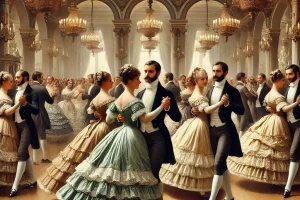
The contradanza was the first European-derived dance form to take root in Cuba and begin transforming under African influence. It is the starting point of the Cuban salon dance lineage that would eventually produce danzón, mambo, and cha-cha-chá.
Lees meer >
The contradanza was the first European-derived dance form to take root in Cuba and begin transforming under African influence. It is the starting point of the Cuban salon dance lineage that would eventually produce danzón, mambo, and cha-cha-chá.
Lees meer > Timba is the music this site is dedicated to exploring. It emerged as a distinct genre in the late 1980s and crystallized in the early 1990s — born in a moment of social crisis, built on the full accumulated history of Cuban music, and still evolving today.
Lees meer >Rumba is the most African-rooted of all Cuban music and dance forms — born in the streets, courtyards, and docks of Havana and Matanzas in the late 19th century, with no European instruments, no salon setting, and no pretense of European propriety.
Lees meer > Cuba is the largest island in the Caribbean and the birthplace of some of the world's most influential music and dance traditions. African, Spanish, and French cultural streams collided here over centuries of colonial history, producing an extraordinary creative culture that exported itself across the globe.
Lees meer >The Caribbean region was a crossroads of African, European, and indigenous cultures during the colonial era. The movement of enslaved people and colonizers between islands created musical and dance traditions that spread across the region and deeply influenced Cuban culture.
Lees meer > Timba, the explosive and rhythmically rich genre of Cuban dance music, transformed how the bass functions in popular music. In Timba, the bass is not just foundational — it’s fiery, funky, and free.
Lees meer >A Cuban popular dance music genre that emerged in the 1980s–90s
- emerged in the 1980s–90s
- influenced by songo, rumba, funk, blues, jazz, pop, rock and Afro-Cuban rhythms.
- Known for complex rhythm shifts, aggressive bass lines, and high energy that push dancers to improvise.
Lees meer >Mambo
In Cuban music, especially in salsa and son,
the "mambo" section typically refers to a brassy, rhythmically intense instrumental break,
often featuring repetitive horn lines, call-and-response patterns, and building energy toward the climax of a song.
The Casa de la Trova in Santiago de Cuba is the spiritual home of Cuban traditional music — Son, Bolero, Changüí, and Trova. Founded in 1968 on Calle Heredia in the heart of Santiago's historic center, it has been the gathering place for the city's musicians for over half a century.
Lees meer >