Cuba
Cuba is the largest island in the Caribbean and the birthplace of some of the world's most influential music and dance traditions. African, Spanish, and French cultural streams collided here over centuries of colonial history, producing an extraordinary creative culture that exported itself across the globe.
Musical Regions
Cuba's geography shaped its musical diversity. The island developed distinct regional traditions that later merged in Havana:
| Region | Key Traditions |
|---|---|
| Havana | Casino, Mambo, Cha-cha-chá, urban Rumba, Timba |
| Matanzas | Danzón, Yambú, Guaguancó, Abakuá, Arara |
| cuba"> Santiago de Cuba | Son, Bolero, Trova |
| Oriente (east) | Son tradicional, Changüí, Nengón, Kiribá |
| Guantánamo | Changüí, Tumba Francesa |
African Roots
Enslaved Africans brought to Cuba came primarily from West and Central Africa — Yoruba ( Nigeria), Kongo (Congo/Cameroon), Fon/Ewe (Dahomey/Benin), and Carabalí (Cross River region). Their religious and musical traditions survived in Cuba through:
- Santería / Regla de Ocha — Yoruba-rooted, gave rise to Orisha dances
- Palo Monte — Kongo-rooted, gave rise to Makuta and Yuka
- Arará — Fon/Ewe-rooted, strongest in Matanzas
- Abakuá — Carabalí secret society, centered in Havana and Matanzas
Spanish Roots
Spanish colonization brought the guitar, violin, and European harmonic structures. Contradanza, Habanera, and later Danzón evolved from European ballroom traditions filtered through Creole culture.
The Cuban Synthesis
The collision of these traditions produced the Cuban musical genius: clave-based rhythm, call-and-response vocal structure, layered percussion, and improvisation within tight formal frameworks. Everything from Son to Timba flows from this synthesis.
Contradanza
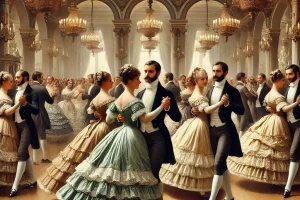
The contradanza was the first European-derived dance form to take root in Cuba and begin transforming under African influence. It is the starting point of the Cuban salon dance lineage that would eventually produce danzón, mambo, and cha-cha-chá.
Lees meer >
Contradanza
The contradanza was the first European-derived dance form to take root in Cuba and begin transforming under African influence. It is the starting point of the Cuban salon dance lineage that would eventually produce danzón, mambo, and cha-cha-chá.
Lees meer >
Danzón
Danzón was the first national dance of Cuba — the form that unified the island's popular music identity in the late 19th and early 20th century, and the ancestor of mambo, cha-cha-chá, and ultimately timba.
Lees meer >
Danzón
Danzón was the first national dance of Cuba — the form that unified the island's popular music identity in the late 19th and early 20th century, and the ancestor of mambo, cha-cha-chá, and ultimately timba.
Lees meer >
Timba
Timba is the music this site is dedicated to exploring. It emerged as a distinct genre in the late 1980s and crystallized in the early 1990s — born in a moment of social crisis, built on the full accumulated history of Cuban music, and still evolving today.
Lees meer >
Rumba
Rumba is the most African-rooted of all Cuban music and dance forms — born in the streets, courtyards, and docks of Havana and Matanzas in the late 19th century, with no European instruments, no salon setting, and no pretense of European propriety.
Lees meer >
Rumba
Rumba is the most African-rooted of all Cuban music and dance forms — born in the streets, courtyards, and docks of Havana and Matanzas in the late 19th century, with no European instruments, no salon setting, and no pretense of European propriety.
Lees meer >
Rumba
Rumba is the most African-rooted of all Cuban music and dance forms — born in the streets, courtyards, and docks of Havana and Matanzas in the late 19th century, with no European instruments, no salon setting, and no pretense of European propriety.
Lees meer >
Rumba
Rumba is the most African-rooted of all Cuban music and dance forms — born in the streets, courtyards, and docks of Havana and Matanzas in the late 19th century, with no European instruments, no salon setting, and no pretense of European propriety.
Lees meer >
Bolero Cubano
The Cuban bolero is one of the great romantic song traditions of the world — slow, intimate, and deeply emotional. It is entirely distinct from the Spanish bolero (a fast 3/4 dance) and emerged in Cuba as a vehicle for the island's most heartfelt lyric expression.
Lees meer >
Bolero Cubano
The Cuban bolero is one of the great romantic song traditions of the world — slow, intimate, and deeply emotional. It is entirely distinct from the Spanish bolero (a fast 3/4 dance) and emerged in Cuba as a vehicle for the island's most heartfelt lyric expression.
Lees meer >
Cha-cha-chá
The cha-cha-chá was born from a simple observation: dancers were struggling to follow mambo. Its creator gave them a rhythm they could feel in their feet — and the result became one of the most danced music styles in history.
Lees meer >
Nengón and Changüí
Before son, before danzón, before any of the named genres — there was Nengón and Changüí in the mountains and valleys of eastern Cuba (Oriente, especially Guantánamo province). These are the oldest surviving roots of Cuban popular music.
Lees meer >
Nengón and Changüí
Before son, before danzón, before any of the named genres — there was Nengón and Changüí in the mountains and valleys of eastern Cuba (Oriente, especially Guantánamo province). These are the oldest surviving roots of Cuban popular music.
Lees meer >
Casino
Casino is the Cuban partner dance born in the social clubs (casinos deportivos) of Havana in the 1950s. It is what Cubans call their own social dance — distinct from, and older than, what the rest of the world calls "salsa."
Lees meer >
Cuba
Cuba is the largest island in the Caribbean and the birthplace of some of the world's most influential music and dance traditions. African, Spanish, and French cultural streams collided here over centuries of colonial history, producing an extraordinary creative culture that exported itself across the globe.
Lees meer >
Matanzas
The following dances have their origin in Matanzas:
- Rumba
- Yambú
- Guaguancó
- Danzón
- Abakuá
-
Arara
Lees meer >
Casa de la Trova Matanzas
Matanzas has its own trova"> Casa de la Trova, reflecting the city's deep musical culture. Often called the "Athens of Cuba" for its cultural richness, Matanzas is the birthplace of Danzón, the stronghold of Rumba (particularly Yambú and Guaguancó), and home to the oldest living Abakuá and Arará traditions.
Lees meer >
Casa de la Trova
The Casa de la Trova in Santiago de Cuba is the spiritual home of Cuban traditional music — Son, Bolero, Changüí, and Trova. Founded in 1968 on Calle Heredia in the heart of Santiago's historic center, it has been the gathering place for the city's musicians for over half a century.
Lees meer >
Caribbean Region
The Caribbean region was a crossroads of African, European, and indigenous cultures during the colonial era. The movement of enslaved people and colonizers between islands created musical and dance traditions that spread across the region and deeply influenced Cuban culture.
Lees meer >
Africa
Afro-Cuban Dances by African Origin
| African Region / Ethnic Group | Cuban Religions / Traditions | Cuban Dances / Genres |
|---|---|---|
| Nigeria ( Yoruba) | Santería (Regla de Ocha) | Orisha dances (to Shango, Yemayá, Ochún, Elegguá, etc.); staged folkloric Yoruba dances; influence on Rumba & Son movement |
| Nigeria (Igbo / Efik) | Lesser-preserved lineages | Ritual dances in some Afro-Cuban ceremonies, body isolations integrated into popular dance |
| Cameroon–Congo ( Bantu/Kongo) | Palo Monte (Regla de Palo), Congo cabildos | Palo dances, Makuta, Yuka; Congo-style dances; major influence on Rumba ( Columbia & Guaguancó) |
| Dahomey (Fon/Ewe, Benin area) | Arará religion ( Matanzas) | Arará ritual dances, with distinctive footwork and body undulations |
| Carabalí (Calabar, SE Nigeria– Cameroon border) | Abakuá society | Secret society dances (ekón, plante), influence on male rumba styles |
| European (Spanish / French) | Secular ballroom, Creole culture | Contradanza, Habanera, Danzón, Cha-cha-chá, Mambo, etc. |
| Mixed Creole (African + European) | Popular Cuban music & dance | Son, Rumba, Salsa, Casino ( Cuban salsa), Timba |
Contradanza
The contradanza was the first European-derived dance form to take root in Cuba and begin transforming under African influence. It is the starting point of the Cuban salon dance lineage that would eventually produce danzón, mambo, and cha-cha-chá.
Lees meer >
Contradanza
The contradanza was the first European-derived dance form to take root in Cuba and begin transforming under African influence. It is the starting point of the Cuban salon dance lineage that would eventually produce danzón, mambo, and cha-cha-chá.
Lees meer >
Danzón
Danzón was the first national dance of Cuba — the form that unified the island's popular music identity in the late 19th and early 20th century, and the ancestor of mambo, cha-cha-chá, and ultimately timba.
Lees meer >
Danzón
Danzón was the first national dance of Cuba — the form that unified the island's popular music identity in the late 19th and early 20th century, and the ancestor of mambo, cha-cha-chá, and ultimately timba.
Lees meer >
Timba
Timba is the music this site is dedicated to exploring. It emerged as a distinct genre in the late 1980s and crystallized in the early 1990s — born in a moment of social crisis, built on the full accumulated history of Cuban music, and still evolving today.
Lees meer >
Rumba
Rumba is the most African-rooted of all Cuban music and dance forms — born in the streets, courtyards, and docks of Havana and Matanzas in the late 19th century, with no European instruments, no salon setting, and no pretense of European propriety.
Lees meer >
Rumba
Rumba is the most African-rooted of all Cuban music and dance forms — born in the streets, courtyards, and docks of Havana and Matanzas in the late 19th century, with no European instruments, no salon setting, and no pretense of European propriety.
Lees meer >
Rumba
Rumba is the most African-rooted of all Cuban music and dance forms — born in the streets, courtyards, and docks of Havana and Matanzas in the late 19th century, with no European instruments, no salon setting, and no pretense of European propriety.
Lees meer >
Cha-cha-chá
The cha-cha-chá was born from a simple observation: dancers were struggling to follow mambo. Its creator gave them a rhythm they could feel in their feet — and the result became one of the most danced music styles in history.
Lees meer >
Casino
Casino is the Cuban partner dance born in the social clubs (casinos deportivos) of Havana in the 1950s. It is what Cubans call their own social dance — distinct from, and older than, what the rest of the world calls "salsa."
Lees meer >
Casino
Casino is the Cuban partner dance born in the social clubs (casinos deportivos) of Havana in the 1950s. It is what Cubans call their own social dance — distinct from, and older than, what the rest of the world calls "salsa."
Lees meer >
Matanzas
The following dances have their origin in Matanzas:
- Rumba
- Yambú
- Guaguancó
- Danzón
- Abakuá
-
Arara
Lees meer >
Casa de la Trova
The Casa de la Trova in Santiago de Cuba is the spiritual home of Cuban traditional music — Son, Bolero, Changüí, and Trova. Founded in 1968 on Calle Heredia in the heart of Santiago's historic center, it has been the gathering place for the city's musicians for over half a century.
Lees meer >
Nigeria
Nigeria — home to the Yoruba, Igbo, and Efik peoples — is the single most influential African source for Afro-Cuban religion and dance. Enslaved Yoruba brought to Cuba preserved their cosmology through Santería, and their descendants' dances remain at the core of Cuban folkloric and popular movement vocabulary today.
Lees meer >
Nigeria
Nigeria — home to the Yoruba, Igbo, and Efik peoples — is the single most influential African source for Afro-Cuban religion and dance. Enslaved Yoruba brought to Cuba preserved their cosmology through Santería, and their descendants' dances remain at the core of Cuban folkloric and popular movement vocabulary today.
Lees meer >
Cameroon
The Cameroon–Congo region was home to the Bantu and Kongo peoples whose descendants were brought to Cuba as enslaved people, primarily between the 17th and 19th centuries. Their cultural heritage survives in Cuba through Palo Monte, and in the dances Makuta and Yuka.
Lees meer >
Cameroon
The Cameroon–Congo region was home to the Bantu and Kongo peoples whose descendants were brought to Cuba as enslaved people, primarily between the 17th and 19th centuries. Their cultural heritage survives in Cuba through Palo Monte, and in the dances Makuta and Yuka.
Lees meer >
Palo
Palo
Palo is an Afro-Cuban religion with various denominations that developed among Central African slaves and their descendants, particularly those of Congo and Bantu origin.
The Spanish word palo (“stick”) refers to the wooden sticks used in the construction of ritual altars—called la Nganga, el caldero, or la prenda.
Denominations (“Branches”) of Palo
- Mayombe (or Mallombe)
- Monte
- Briyumba (or Brillumba)
- Kimbisa
Practitioners
Priests and initiates of Palo are called:
- Paleros
- Tatas (male priests)
- Yayas (female priests)
- Nganguleros
Core Beliefs
The Palo belief system rests on two foundational pillars:
- Honor of the spirits
- Belief in natural / earth powers
All natural objects—especially sticks—are understood to contain spiritual power, typically connected to the spirits themselves. This differs from Santería and other Yoruba religions, whose orishas are more closely associated with human or anthropomorphic forms.
Distinctive Traits
- No deity-specific colors, clothing, or stylized dances (unlike Santería).
- Ritual emphasis on natural objects and the nganga.
Music in Palo Rituals
Palo music typically begins with wooden percussion, followed by drums and metal tools.
Wooden instruments:
- Catá
- Guaguá
Drums:
- Ngoma (conga-style drums)
Metal instruments:
- Cowbell
- Hoe
- Plow
Higher Deities and Syncretism
Nkuyu
Also known as: Mukudji, Nkuyu, Mañunga, Lubaniba, Lucero, Lucero Mundo, Remolino, Cuarto Vientos, Kbuyu
- Deity of forests and roads; a guide and balancer
- Guardian of cemetery entrances
- Associated with the moon
- Syncretized with Eleguá/Eshu (Yoruba) and the Holy Infant of Atocha
Kengue
Also known as: Mama Kengue, Yola, Tiembla Tierra, Pandilanga
- Sky Father and primordial creator
- Deity of knowledge and justice
- Equivalent to Obatalá (Yoruba)
- Syncretized with the Virgin of Mercy
Sarabanda
Also known as: Zarabanda, Rompe Monte
- Strong, forceful, willful deity
- Equivalent to Ogún (Yoruba)
- Associated with Saint Peter
El Christo Negro
- Black manifestation of Jesus Christ
- Considered all-powerful; all spirits bow to his authority
- Symbolically linked with black crows and black roosters
Mama Chola
Also known as: Chola Wengue
- Goddess of love, beauty, fertility, and prosperity
- Ruler of rivers and fresh water — all that flows, grows, and is renewed
- Equivalent to Oshún (Yoruba)
- Syncretized with Our Lady of Charity (La Virgen de la Caridad del Cobre), Cuba's patron saint
Yuka
Yuka is considered the oldest surviving Kongo-derived dance form in Cuba and the most direct ancestor of Rumba. Preserved by Congo-descent communities from the era of slavery onward, Yuka contains the movement vocabulary, the drum format, and the social dynamic that would eventually transform into one of Cuba's defining popular dance traditions.
Lees meer >
Makuta
Makuta is a secular Kongo-derived dance of the Congo-descent communities of Cuba — vigorous, grounded, and celebratory. It belongs to the oldest layer of African-Cuban cultural expression and represents a direct continuation of Central African movement and musical traditions preserved across centuries of slavery and colonial life.
Lees meer >
Chango
Changó is the Orisha of thunder, lightning, fire, and kingship — a warrior king celebrated for his passion, virility, and love of music and dance. His dance is one of the most explosive and athletic in the Orisha repertoire.
Lees meer >
Egungun
Egungun is the Yoruba masquerade tradition honoring the collective ancestors — the Egun, the dead who remain present and active in the lives of the living. In Cuba, the Egungun tradition survived within the broader world of Santería (Regla de Ocha) and the related Arará and Abakuá communities, though in a form shaped by the specific conditions of the island.
Lees meer >
Arará
Arará is a vibrant Afro-Cuban dance rooted in the religious and cultural traditions of the Dahomey people, characterized by rhythmic drumming, expressive movements, and deep spiritual significance.
Lees meer >
Abakuá
Abakuá is a male secret society that originated in Cuba in the early 1800s, specifically in Regla, Havana, in 1836. It was created by enslaved and free Afro-Cubans who brought traditions from the Ekpe societies of the Efik, Ibibio, and Ejagham peoples in the Cross River region of southeastern Nigeria and southwestern Cameroon.
Lees meer >
Yemayá
Yemayá is the Orisha of the sea and the mother of all Orishas. She governs the saltwater ocean and all living things within it. As mother, she is nurturing, protective — and when angered, devastating.
Lees meer >
Timba music
A Cuban popular dance music genre that emerged in the 1980s–90s
- emerged in the 1980s–90s
- influenced by songo, rumba, funk, blues, jazz, pop, rock and Afro-Cuban rhythms.
- Known for complex rhythm shifts, aggressive bass lines, and high energy that push dancers to improvise.
Lees meer >
Mambo
In Cuban music, especially in salsa and son, the "mambo" section typically refers to a brassy, rhythmically intense instrumental break, often featuring repetitive horn lines, call-and-response patterns, and building energy toward the climax of a song.
Casa de la Trova
The Casa de la Trova in Santiago de Cuba is the spiritual home of Cuban traditional music — Son, Bolero, Changüí, and Trova. Founded in 1968 on Calle Heredia in the heart of Santiago's historic center, it has been the gathering place for the city's musicians for over half a century.
Lees meer >
Nigeria
Nigeria — home to the Yoruba, Igbo, and Efik peoples — is the single most influential African source for Afro-Cuban religion and dance. Enslaved Yoruba brought to Cuba preserved their cosmology through Santería, and their descendants' dances remain at the core of Cuban folkloric and popular movement vocabulary today.
Lees meer >
Nigeria
Nigeria — home to the Yoruba, Igbo, and Efik peoples — is the single most influential African source for Afro-Cuban religion and dance. Enslaved Yoruba brought to Cuba preserved their cosmology through Santería, and their descendants' dances remain at the core of Cuban folkloric and popular movement vocabulary today.
Lees meer >
Cameroon
The Cameroon–Congo region was home to the Bantu and Kongo peoples whose descendants were brought to Cuba as enslaved people, primarily between the 17th and 19th centuries. Their cultural heritage survives in Cuba through Palo Monte, and in the dances Makuta and Yuka.
Lees meer >
Oriente
Oriente, the eastern region of Cuba, is the cradle of vibrant music and dance traditions like Son, Changüí, Nengón, and Kiribá, which shaped the roots of Cuban and Latin music.
Lees meer >
Kiribá
Kiribá is an ancient music and dance tradition from eastern Cuba, closely related to Nengón and Changüí, and considered one of the oldest surviving Afro-Cuban popular forms.
Lees meer >
Palo
Palo
Palo is an Afro-Cuban religion with various denominations that developed among Central African slaves and their descendants, particularly those of Congo and Bantu origin.
The Spanish word palo (“stick”) refers to the wooden sticks used in the construction of ritual altars—called la Nganga, el caldero, or la prenda.
Denominations (“Branches”) of Palo
- Mayombe (or Mallombe)
- Monte
- Briyumba (or Brillumba)
- Kimbisa
Practitioners
Priests and initiates of Palo are called:
- Paleros
- Tatas (male priests)
- Yayas (female priests)
- Nganguleros
Core Beliefs
The Palo belief system rests on two foundational pillars:
- Honor of the spirits
- Belief in natural / earth powers
All natural objects—especially sticks—are understood to contain spiritual power, typically connected to the spirits themselves. This differs from Santería and other Yoruba religions, whose orishas are more closely associated with human or anthropomorphic forms.
Distinctive Traits
- No deity-specific colors, clothing, or stylized dances (unlike Santería).
- Ritual emphasis on natural objects and the nganga.
Music in Palo Rituals
Palo music typically begins with wooden percussion, followed by drums and metal tools.
Wooden instruments:
- Catá
- Guaguá
Drums:
- Ngoma (conga-style drums)
Metal instruments:
- Cowbell
- Hoe
- Plow
Higher Deities and Syncretism
Nkuyu
Also known as: Mukudji, Nkuyu, Mañunga, Lubaniba, Lucero, Lucero Mundo, Remolino, Cuarto Vientos, Kbuyu
- Deity of forests and roads; a guide and balancer
- Guardian of cemetery entrances
- Associated with the moon
- Syncretized with Eleguá/Eshu ( Yoruba) and the Holy Infant of Atocha
Kengue
Also known as: Mama Kengue, Yola, Tiembla Tierra, Pandilanga
- Sky Father and primordial creator
- Deity of knowledge and justice
- Equivalent to Obatalá ( Yoruba)
- Syncretized with the Virgin of Mercy
Sarabanda
Also known as: Zarabanda, Rompe Monte
El Christo Negro
- Black manifestation of Jesus Christ
- Considered all-powerful; all spirits bow to his authority
- Symbolically linked with black crows and black roosters
Mama Chola
Also known as: Chola Wengue
- Goddess of love, beauty, fertility, and prosperity
- Ruler of rivers and fresh water — all that flows, grows, and is renewed
- Equivalent to Oshún ( Yoruba)
- Syncretized with Our Lady of Charity (La Virgen de la Caridad del Cobre), Cuba's patron saint
Cuba
Cuba is the largest island in the Caribbean and the birthplace of some of the world's most influential music and dance traditions. African, Spanish, and French cultural streams collided here over centuries of colonial history, producing an extraordinary creative culture that exported itself across the globe.
Lees meer >
Nigeria
Nigeria — home to the Yoruba, Igbo, and Efik peoples — is the single most influential African source for Afro-Cuban religion and dance. Enslaved Yoruba brought to Cuba preserved their cosmology through Santería, and their descendants' dances remain at the core of Cuban folkloric and popular movement vocabulary today.
Lees meer >
Cameroon
The Cameroon–Congo region was home to the Bantu and Kongo peoples whose descendants were brought to Cuba as enslaved people, primarily between the 17th and 19th centuries. Their cultural heritage survives in Cuba through Palo Monte, and in the dances Makuta and Yuka.
Lees meer >
Orishas
Afro-Cuban Orishas are deities from the Yoruba religion, brought to Cuba through the transatlantic slave trade, who embody natural forces and human traits, and are honored through music, dance, and ritual in Santería.
Lees meer >
Egungun
Egungun is the Yoruba masquerade tradition honoring the collective ancestors — the Egun, the dead who remain present and active in the lives of the living. In Cuba, the Egungun tradition survived within the broader world of Santería (Regla de Ocha) and the related Arará and Abakuá communities, though in a form shaped by the specific conditions of the island.
Lees meer >
Ogún
Ogún is the Orisha of iron, war, labor, and technology. He is the patron of blacksmiths, soldiers, surgeons, and anyone who works with metal or tools.
Lees meer >
Eleguá
Eleguá is the Orisha of crossroads, beginnings, and communication. He is always the first Orisha invoked in any ceremony — without his permission, the path to the other Orishas is closed.
Lees meer >
Obatalá
Obatalá is the Orisha of purity, wisdom, and creation. He is the father of all Orishas and the sculptor who molded the human body from clay.
Lees meer >
Percussion Instruments
Cuban music is built on percussion. The extraordinary density and variety of Cuban rhythmic culture reflects the meeting of West and Central African drumming traditions with Spanish, Haitian, and creole musical practices over four centuries. The instruments below form the core percussive vocabulary heard across Son, Rumba, Timba, Danzón, and their descendants.
Lees meer >
Yuka
Yuka is considered the oldest surviving Kongo-derived dance form in Cuba and the most direct ancestor of Rumba. Preserved by Congo-descent communities from the era of slavery onward, Yuka contains the movement vocabulary, the drum format, and the social dynamic that would eventually transform into one of Cuba's defining popular dance traditions.
Lees meer >
Makuta
Makuta is a secular Kongo-derived dance of the Congo-descent communities of Cuba — vigorous, grounded, and celebratory. It belongs to the oldest layer of African-Cuban cultural expression and represents a direct continuation of Central African movement and musical traditions preserved across centuries of slavery and colonial life.
Lees meer >
Egungun
Egungun is the Yoruba masquerade tradition honoring the collective ancestors — the Egun, the dead who remain present and active in the lives of the living. In Cuba, the Egungun tradition survived within the broader world of Santería (Regla de Ocha) and the related Arará and Abakuá communities, though in a form shaped by the specific conditions of the island.
Lees meer >
Arará
Arará is a vibrant Afro-Cuban dance rooted in the religious and cultural traditions of the Dahomey people, characterized by rhythmic drumming, expressive movements, and deep spiritual significance.
Lees meer >
Abakuá
Abakuá is a male secret society that originated in Cuba in the early 1800s, specifically in Regla, Havana, in 1836. It was created by enslaved and free Afro-Cubans who brought traditions from the Ekpe societies of the Efik, Ibibio, and Ejagham peoples in the Cross River region of southeastern Nigeria and southwestern Cameroon.
Lees meer >
Percussion Instruments
Cuban music is built on percussion. The extraordinary density and variety of Cuban rhythmic culture reflects the meeting of West and Central African drumming traditions with Spanish, Haitian, and creole musical practices over four centuries. The instruments below form the core percussive vocabulary heard across Son, Rumba, Timba, Danzón, and their descendants.
Lees meer >
Guitar
The Spanish guitar arrived in Cuba with the colonizers and became the seed of Cuban music, blending with African rhythms. From inspiring the tres to shaping son, conjuntos, and even modern timba, its influence runs through every note of Cuba’s musical history.
Lees meer >
Violin
In timba (the Cuban genre that evolved from son and salsa in the late 1980s and 1990s), the violin is not a core instrument, but it does appear in interesting ways:
Lees meer >
Timba music
A Cuban popular dance music genre that emerged in the 1980s–90s
- emerged in the 1980s–90s
- influenced by songo, rumba, funk, blues, jazz, pop, rock and Afro-Cuban rhythms.
- Known for complex rhythm shifts, aggressive bass lines, and high energy that push dancers to improvise.
Lees meer >
Mambo
In Cuban music, especially in salsa and son, the "mambo" section typically refers to a brassy, rhythmically intense instrumental break, often featuring repetitive horn lines, call-and-response patterns, and building energy toward the climax of a song.
Casa de la Trova
The Casa de la Trova in Santiago de Cuba is the spiritual home of Cuban traditional music — Son, Bolero, Changüí, and Trova. Founded in 1968 on Calle Heredia in the heart of Santiago's historic center, it has been the gathering place for the city's musicians for over half a century.
Lees meer >