Danza - dance
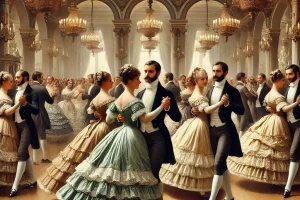
Danza is the evolutionary step between contradanza and danzón — Cuba's first true couple's dance, more intimate and more African in character than the European formations it replaced.
Origins
The Danza developed through the 1840s–1870s as Cuban composers simplified the contradanza into shorter, more intimate pieces designed specifically for two people dancing together. It was the dominant salon form in Havana and matanzas"> Matanzas before danzón took over in 1879.
Dance Character
Danza was a significant departure from contradanza:
- Pure couple's dance — no group formations, no caller; just two people
- Closer embrace — more physical contact than contradanza allowed
- Hip movement beginning — the body started engaging more fully with the syncopated rhythm, hips moving as a natural consequence of the musical pulse
- Sensual quality — by contradanza standards, danza was considered provocative; it pushed the boundary of what was socially acceptable in the salon
This was the habanera rhythm asserting itself more strongly through the body of the dancer.
Musical Connection
The danza had two sections — an introductory A section and a more rhythmically active B section — that the couple danced through continuously without stopping. This was the predecessor of danzón's more elaborate multi-section structure.
Compositionally, the piano danzas of Ignacio Cervantes are considered masterworks — technically sophisticated pieces that blend European classical technique with Cuban rhythmic life.
Today
Like the contradanza, the danza is primarily of historical interest today — it is not danced socially. It appears in musicological research, concert performances of Cervantes' piano danzas, and folk cultural contexts. Its living legacy is in everything that came after it: danzón, son, and the entire Cuban dance lineage.
The contradanza was the first European-derived dance form to take root in Cuba and begin transforming under African influence. It is the starting point of the Cuban salon dance lineage that would eventually produce danzón, mambo"> mambo, and cha-cha-chá.
Lees meer >
The contradanza was the first European-derived dance form to take root in Cuba and begin transforming under African influence. It is the starting point of the Cuban salon dance lineage that would eventually produce danzón, mambo"> mambo, and cha-cha-chá.
Lees meer >Danzón was the first national dance of Cuba — the form that unified the island's popular music identity in the late 19th and early 20th century, and the ancestor of mambo"> mambo, cha-cha-chá, and ultimately timba"> timba.
Lees meer >Rumba is the most African-rooted of all Cuban music and dance forms — born in the streets, courtyards, and docks of Havana and matanzas"> Matanzas in the late 19th century, with no European instruments, no salon setting, and no pretense of European propriety.
Lees meer >Cuba is the largest island in the Caribbean and the birthplace of some of the world's most influential music and dance traditions. African, Spanish, and French cultural streams collided here over centuries of colonial history, producing an extraordinary creative culture that exported itself across the globe.
Lees meer >The following dances have their origin in Matanzas:
The Casa de la Trova in santiago de cuba"> Santiago de Cuba is the spiritual home of Cuban traditional music — Son, Bolero, Changüí, and Trova. Founded in 1968 on Calle Heredia in the heart of Santiago's historic center, it has been the gathering place for the city's musicians for over half a century.
Lees meer >The piano is the harmonic and rhythmic heart of Cuban popular music. In timba"> timba, it is one of the most demanding and expressive instruments in the ensemble.
Lees meer >