Africa - place
Afro-Cuban Dances by African Origin
| African Region / Ethnic Group | Cuban Religions / Traditions | Cuban Dances / Genres |
|---|---|---|
| Nigeria ( Yoruba) | Santería (Regla de Ocha) | Orisha dances (to Shango, Yemayá, Ochún, Elegguá, etc.); staged folkloric Yoruba dances; influence on Rumba & Son movement |
| Nigeria (Igbo / Efik) | Lesser-preserved lineages | Ritual dances in some Afro-Cuban ceremonies, body isolations integrated into popular dance |
| Cameroon–Congo ( Bantu/Kongo) | Palo Monte (Regla de Palo), Congo cabildos | Palo dances, Makuta, Yuka; Congo-style dances; major influence on Rumba ( Columbia & Guaguancó) |
| Dahomey (Fon/Ewe, Benin area) | Arará religion ( Matanzas) | Arará ritual dances, with distinctive footwork and body undulations |
| Carabalí (Calabar, SE Nigeria– Cameroon border) | Abakuá society | Secret society dances (ekón, plante), influence on male rumba styles |
| European (Spanish / French) | Secular ballroom, Creole culture | Contradanza, Habanera, Danzón, Cha-cha-chá, Mambo, etc. |
| Mixed Creole (African + European) | Popular Cuban music & dance | Son, Rumba, Salsa, Casino ( Cuban salsa), Timba |
Contradanza
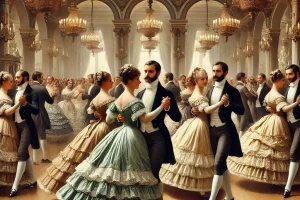
De contradanza was de eerste Europees-afgeleide dansvorm die wortel schoot in Cuba en begon te transformeren onder Afrikaanse invloed. Het is het beginpunt van de Cubaanse salondanslijn die uiteindelijk danzón, mambo en cha-cha-chá zou voortbrengen.
Lees meer >
Contradanza
De contradanza was de eerste Europees-afgeleide dansvorm die wortel schoot in Cuba en begon te transformeren onder Afrikaanse invloed. Het is het beginpunt van de Cubaanse salondanslijn die uiteindelijk danzón, mambo en cha-cha-chá zou voortbrengen.
Lees meer >
Danzón
Danzón was de eerste nationale dans van Cuba — de vorm die in de late 19e en vroege 20e eeuw de identiteit van de Cubaanse populaire muziek verenigde, en de voorloper van mambo, cha-cha-chá en uiteindelijk timba.
Lees meer >
Danzón
Danzón was de eerste nationale dans van Cuba — de vorm die in de late 19e en vroege 20e eeuw de identiteit van de Cubaanse populaire muziek verenigde, en de voorloper van mambo, cha-cha-chá en uiteindelijk timba.
Lees meer >
Timba
Timba is the music this site is dedicated to exploring. It emerged as a distinct genre in the late 1980s and crystallized in the early 1990s — born in a moment of social crisis, built on the full accumulated history of Cuban music, and still evolving today.
Lees meer >
Rumba
Rumba is de meest Afrikaans-gewortelde van alle Cubaanse muziek- en dansvormen — geboren op de straten, binnenplaatsen en kades van Havana en Matanzas aan het einde van de 19e eeuw, zonder Europese instrumenten, geen salonomgeving en geen schijn van Europese fatsoenlijkheid.
Lees meer >
Rumba
Rumba is de meest Afrikaans-gewortelde van alle Cubaanse muziek- en dansvormen — geboren op de straten, binnenplaatsen en kades van Havana en Matanzas aan het einde van de 19e eeuw, zonder Europese instrumenten, geen salonomgeving en geen schijn van Europese fatsoenlijkheid.
Lees meer >
Rumba
Rumba is de meest Afrikaans-gewortelde van alle Cubaanse muziek- en dansvormen — geboren op de straten, binnenplaatsen en kades van Havana en Matanzas aan het einde van de 19e eeuw, zonder Europese instrumenten, geen salonomgeving en geen schijn van Europese fatsoenlijkheid.
Lees meer >
Cha-cha-chá
De cha-cha-chá werd geboren uit een eenvoudige observatie: dansers hadden moeite om mambo te volgen. De bedenker gaf hen een ritme dat ze in hun voeten konden voelen — en het resultaat werd een van de meest gedanste muziekstijlen in de geschiedenis.
Lees meer >
Casino
Casino is de Cubaanse paardans geboren in de sociale clubs (casinos deportivos) van Havana in de jaren 1950. Het is wat Cubanen hun eigen sociale dans noemen — onderscheidend van, en ouder dan, wat de rest van de wereld "salsa" noemt.
Lees meer >
Casino
Casino is de Cubaanse paardans geboren in de sociale clubs (casinos deportivos) van Havana in de jaren 1950. Het is wat Cubanen hun eigen sociale dans noemen — onderscheidend van, en ouder dan, wat de rest van de wereld "salsa" noemt.
Lees meer >
Matanzas
The following dances have their origin in Matanzas:
- Rumba
- Yambú
- Guaguancó
- Danzón
- Abakuá
-
Arara
Lees meer >
Casa de la Trova
The Casa de la Trova in cuba"> Santiago de Cuba is the spiritual home of Cuban traditional music — Son, Bolero, Changüí, and Trova. Founded in 1968 on Calle Heredia in the heart of Santiago's historic center, it has been the gathering place for the city's musicians for over half a century.
Lees meer >
Nigeria
Nigeria — home to the Yoruba, Igbo, and Efik peoples — is the single most influential African source for Afro-Cuban religion and dance. Enslaved Yoruba brought to Cuba preserved their cosmology through Santería, and their descendants' dances remain at the core of Cuban folkloric and popular movement vocabulary today.
Lees meer >
Nigeria
Nigeria — home to the Yoruba, Igbo, and Efik peoples — is the single most influential African source for Afro-Cuban religion and dance. Enslaved Yoruba brought to Cuba preserved their cosmology through Santería, and their descendants' dances remain at the core of Cuban folkloric and popular movement vocabulary today.
Lees meer >
Cameroon
The Cameroon–Congo region was home to the Bantu and Kongo peoples whose descendants were brought to Cuba as enslaved people, primarily between the 17th and 19th centuries. Their cultural heritage survives in Cuba through Palo Monte, and in the dances Makuta and Yuka.
Lees meer >
Cameroon
The Cameroon–Congo region was home to the Bantu and Kongo peoples whose descendants were brought to Cuba as enslaved people, primarily between the 17th and 19th centuries. Their cultural heritage survives in Cuba through Palo Monte, and in the dances Makuta and Yuka.
Lees meer >
Palo
Palo
Palo is een Afro-Cubaanse religie met verschillende denominaties die zich ontwikkelde onder Centraal-Afrikaanse slaven en hun nakomelingen, met name die van Kongo en Bantú afkomst. Het Spaanse woord palo ("stok") verwijst naar de houten stokken die worden gebruikt bij de constructie van rituele altaren — la Nganga, el caldero of la prenda genaamd.
Denominaties ("Takken") van Palo
- Mayombe (of Mallombe)
- Monte
- Briyumba (of Brillumba)
- Kimbisa
Beoefenaars
Priesters en ingewijden van Palo worden genoemd:
- Paleros
- Tatas (mannelijke priesters)
- Yayas (vrouwelijke priesters)
- Nganguleros
Kernovertuigingen
Het Palo-geloofsysteem rust op twee fundamentele pijlers:
- Eer van de geesten
- Geloof in natuurlijke / aardse krachten
Alle natuurlijke objecten — met name stokken — worden begrepen als spirituele kracht bevattend. Dit verschilt van Santería en andere Yoruba-religies, wier orishas meer geassocieerd zijn met menselijke of antropomorfe vormen.
Onderscheidende kenmerken
- Geen godheidsspecifieke kleuren, kleding of gestileerde dansen (in tegenstelling tot Santería).
- Rituele nadruk op natuurlijke objecten en de nganga.
Muziek in Palo-rituelen
Palo-muziek begint doorgaans met houten percussie, gevolgd door trommen en metalen gereedschappen.
Houten instrumenten:
- Catá
- Guaguá
Trommen:
- Ngoma (congatype trommen)
Metalen instrumenten:
- Koeienbel
- Hak
- Ploeg
Hogere Goden en Syncretisme
Nkuyu
Ook bekend als: Mukudji, Nkuyu, Mañunga, Lubaniba, Lucero, Lucero Mundo, Remolino, Cuarto Vientos, Kbuyu
- Godheid van bossen en wegen; een gids en balanceerder
- Bewaker van kerkhofingangen
- Geassocieerd met de maan
- Gesyncretiseerd met Eleguá/Eshu (Yoruba) en het Heilig Kind van Atocha
Kengue
Ook bekend als: Mama Kengue, Yola, Tiembla Tierra, Pandilanga
- Hemelvader en primordiale schepper
- Godheid van kennis en rechtvaardigheid
- Equivalent aan Obatalá (Yoruba)
- Gesyncretiseerd met de Maagd van Barmhartigheid
Sarabanda
Ook bekend als: Zarabanda, Rompe Monte
- Sterke, krachtige, eigenzinnige godheid
- Equivalent aan Ogún (Yoruba)
- Geassocieerd met Sint Petrus
El Christo Negro
- Zwarte manifestatie van Jezus Christus
- Wordt als almachtig beschouwd; alle geesten buigen voor zijn autoriteit
- Symbolisch verbonden met zwarte kraaien en zwarte hanen
Mama Chola
Ook bekend als: Chola Wengue
- Godin van liefde, schoonheid, vruchtbaarheid en voorspoed
- Heerseres over rivieren en zoet water — alles wat stroomt, groeit en vernieuwt
- Equivalent aan Oshún (Yoruba)
- Gesyncretiseerd met Onze-Lieve-Vrouw van de Naastenliefde (La Virgen de la Caridad del Cobre), de beschermheilige van Cuba
Yuka
Yuka wordt beschouwd als de oudste overgebleven Kongo-afgeleide dansvorm in Cuba en de meest directe voorouder van Rumba. Bewaard door Congo-afstammingsgemeenschappen vanaf het tijdperk van de slavernij, bevat Yuka het bewegingsvocabulaire, het drumformaat en de sociale dynamiek die uiteindelijk zou transformeren tot een van Cuba's bepalende populaire danstradities.
Lees meer >
Makuta
Makuta is een seculiere Kongo-afgeleide dans van de Congo-afstammingsgemeenschappen van Cuba — krachtig, geaard en feestelijk. Het behoort tot de oudste laag van Afrikaans-Cubaanse culturele expressie en vertegenwoordigt een directe voortzetting van Centraal-Afrikaanse bewegings- en muzikale tradities die door eeuwen van slavernij en koloniaal leven zijn bewaard.
Lees meer >
Chango
Changó is de Orisha van donder, bliksem, vuur en koningschap — een krijgerskoning geroemd om zijn passie, viriliteit en liefde voor muziek en dans. Zijn dans is een van de meest explosieve en atletische uit het Orisha-repertoire.
Lees meer >
Egungun
Egungun is de Yoruba-maskertraditie ter ere van de collectieve voorouders — de Egun, de doden die aanwezig en actief blijven in het leven van de levenden. In Cuba overleefde de Egungun-traditie binnen de bredere wereld van Santería (Regla de Ocha) en de gerelateerde Arará en Abakuá-gemeenschappen.
Lees meer >
Arará
Arará is een levendige Afro-Cubaanse dans geworteld in de religieuze en culturele tradities van het Dahomeyse volk, gekenmerkt door ritmisch trommelspel, expressieve bewegingen en diepe spirituele betekenis.
Lees meer >
Yemayá
Yemayá is de Orisha van de zee en de moeder van alle Orishas. Zij beheerst de zoute oceaan en alle levende wezens daarin. Als moeder is ze voedend en beschermend — en wanneer ze vertoornd raakt, verwoestend.
Lees meer >
Timba muziek
Een Cubaans populair dansmuziekgenre dat ontstond in de jaren 1980–90
- Ontstaan in de jaren 1980–90
- Beïnvloed door songo, rumba, funk, blues, jazz, pop, rock en Afro-Cubaanse ritmes.
- Bekend om complexe ritmewisselingen, agressieve baslijnen en hoge energie die dansers aanzet tot improvisatie.
Lees meer >
Mambo
In Cubaanse muziek, met name in salsa en son, verwijst het "mambo"-gedeelte doorgaans naar een krachtige, ritmisch intense instrumentale break, die vaak repetitieve hoornlijnen, call-and-response-patronen en opbouwende energie naar het hoogtepunt van een nummer bevat.
Casa de la Trova
The Casa de la Trova in cuba"> Santiago de Cuba is the spiritual home of Cuban traditional music — Son, Bolero, Changüí, and Trova. Founded in 1968 on Calle Heredia in the heart of Santiago's historic center, it has been the gathering place for the city's musicians for over half a century.
Lees meer >