Africa - place
Afro-Cuban Dances by African Origin
| African Region / Ethnic Group | Cuban Religions / Traditions | Cuban Dances / Genres |
|---|---|---|
| Nigeria ( Yoruba) | Santería (Regla de Ocha) | Orisha dances (to Shango, Yemayá, Ochún, Elegguá, etc.); staged folkloric Yoruba dances; influence on Rumba & Son movement |
| Nigeria (Igbo / Efik) | Lesser-preserved lineages | Ritual dances in some Afro-Cuban ceremonies, body isolations integrated into popular dance |
| Cameroon–Congo ( Bantu/Kongo) | Palo Monte (Regla de Palo), Congo cabildos | Palo dances, Makuta, Yuka; Congo-style dances; major influence on Rumba ( Columbia & Guaguancó) |
| Dahomey (Fon/Ewe, Benin area) | Arará religion ( Matanzas) | Arará ritual dances, with distinctive footwork and body undulations |
| Carabalí (Calabar, SE Nigeria– Cameroon border) | Abakuá society | Secret society dances (ekón, plante), influence on male rumba styles |
| European (Spanish / French) | Secular ballroom, Creole culture | Contradanza, Habanera, Danzón, Cha-cha-chá, Mambo, etc. |
| Mixed Creole (African + European) | Popular Cuban music & dance | Son, Rumba, Salsa, Casino ( Cuban salsa), Timba |
Contradanza
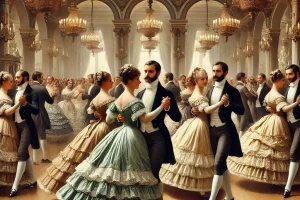
La contradanza fue la primera forma de danza de origen europeo que echó raíces en Cuba y comenzó a transformarse bajo la influencia africana. Es el punto de partida del linaje del baile de salón cubano que eventualmente produciría el danzón, el mambo y el cha-cha-chá.
Lees meer >
Contradanza
La contradanza fue la primera forma de danza de origen europeo que echó raíces en Cuba y comenzó a transformarse bajo la influencia africana. Es el punto de partida del linaje del baile de salón cubano que eventualmente produciría el danzón, el mambo y el cha-cha-chá.
Lees meer >
Danzón
El danzón fue el primer baile nacional de Cuba — la forma que unificó la identidad de la música popular cubana a finales del siglo XIX y principios del XX, y el antepasado del mambo, el cha-cha-chá y, en última instancia, la timba.
Lees meer >
Danzón
El danzón fue el primer baile nacional de Cuba — la forma que unificó la identidad de la música popular cubana a finales del siglo XIX y principios del XX, y el antepasado del mambo, el cha-cha-chá y, en última instancia, la timba.
Lees meer >
Timba
Timba is the music this site is dedicated to exploring. It emerged as a distinct genre in the late 1980s and crystallized in the early 1990s — born in a moment of social crisis, built on the full accumulated history of Cuban music, and still evolving today.
Lees meer >
Rumba
La Rumba es la más arraigada en lo africano de todas las formas de música y danza cubanas — nacida en las calles, los patios y los muelles de La Habana y Matanzas a finales del siglo XIX, sin instrumentos europeos, sin ambiente de salón y sin pretensión alguna de decoro europeo.
Lees meer >
Rumba
La Rumba es la más arraigada en lo africano de todas las formas de música y danza cubanas — nacida en las calles, los patios y los muelles de La Habana y Matanzas a finales del siglo XIX, sin instrumentos europeos, sin ambiente de salón y sin pretensión alguna de decoro europeo.
Lees meer >
Rumba
La Rumba es la más arraigada en lo africano de todas las formas de música y danza cubanas — nacida en las calles, los patios y los muelles de La Habana y Matanzas a finales del siglo XIX, sin instrumentos europeos, sin ambiente de salón y sin pretensión alguna de decoro europeo.
Lees meer >
Cha-cha-chá
El cha-cha-chá nació de una simple observación: los bailarines tenían dificultades para seguir el mambo. Su creador les dio un ritmo que podían sentir en los pies — y el resultado se convirtió en uno de los estilos musicales más bailados de la historia.
Lees meer >
Casino
El Casino es el baile de pareja cubano nacido en los clubes sociales (casinos deportivos) de La Habana en la década de 1950. Es lo que los cubanos llaman su propio baile social — distinto de, y anterior a, lo que el resto del mundo llama "salsa".
Lees meer >
Casino
El Casino es el baile de pareja cubano nacido en los clubes sociales (casinos deportivos) de La Habana en la década de 1950. Es lo que los cubanos llaman su propio baile social — distinto de, y anterior a, lo que el resto del mundo llama "salsa".
Lees meer >
Matanzas
The following dances have their origin in Matanzas:
- Rumba
- Yambú
- Guaguancó
- Danzón
- Abakuá
-
Arara
Lees meer >
Casa de la Trova
The Casa de la Trova in Santiago de Cuba is the spiritual home of Cuban traditional music — Son, Bolero, Changüí, and Trova. Founded in 1968 on Calle Heredia in the heart of Santiago's historic center, it has been the gathering place for the city's musicians for over half a century.
Lees meer >
Nigeria
Nigeria — home to the Yoruba, Igbo, and Efik peoples — is the single most influential African source for Afro-Cuban religion and dance. Enslaved Yoruba brought to Cuba preserved their cosmology through Santería, and their descendants' dances remain at the core of Cuban folkloric and popular movement vocabulary today.
Lees meer >
Nigeria
Nigeria — home to the Yoruba, Igbo, and Efik peoples — is the single most influential African source for Afro-Cuban religion and dance. Enslaved Yoruba brought to Cuba preserved their cosmology through Santería, and their descendants' dances remain at the core of Cuban folkloric and popular movement vocabulary today.
Lees meer >
Cameroon
The Cameroon–Congo region was home to the Bantu and Kongo peoples whose descendants were brought to Cuba as enslaved people, primarily between the 17th and 19th centuries. Their cultural heritage survives in Cuba through Palo Monte, and in the dances Makuta and Yuka.
Lees meer >
Cameroon
The Cameroon–Congo region was home to the Bantu and Kongo peoples whose descendants were brought to Cuba as enslaved people, primarily between the 17th and 19th centuries. Their cultural heritage survives in Cuba through Palo Monte, and in the dances Makuta and Yuka.
Lees meer >
Palo
Palo
El Palo es una religión afrocubana con varias denominaciones que se desarrolló entre los esclavos centroafricanos y sus descendientes, particularmente los de origen Congo y Bantú. La palabra española palo ("palo") se refiere a los palos de madera utilizados en la construcción de los altares rituales — llamados la Nganga, el caldero o la prenda.
Denominaciones ("Ramas") del Palo
- Mayombe (o Mallombe)
- Monte
- Briyumba (o Brillumba)
- Kimbisa
Practicantes
Los sacerdotes e iniciados del Palo se llaman:
- Paleros
- Tatas (sacerdotes masculinos)
- Yayas (sacerdotisas femeninas)
- Nganguleros
Creencias Fundamentales
El sistema de creencias del Palo descansa en dos pilares fundamentales:
- Honor a los espíritus
- Creencia en los poderes naturales / de la tierra
Se entiende que todos los objetos naturales — especialmente los palos — contienen poder espiritual, típicamente conectado a los propios espíritus. Esto difiere de la Santería y otras religiones Yoruba, cuyos orishas están más estrechamente asociados con formas humanas o antropomórficas.
Rasgos Distintivos
- Sin colores, ropa o danzas estilizadas específicos de la deidad (a diferencia de la Santería).
- Énfasis ritual en los objetos naturales y la nganga.
Música en los Rituales de Palo
La música del Palo típicamente comienza con percusión de madera, seguida de tambores e instrumentos de metal.
Instrumentos de madera:
- Catá
- Guaguá
Tambores:
- Ngoma (tambores tipo conga)
Instrumentos de metal:
- Cencerro
- Azada
- Arado
Deidades Superiores y Sincretismo
Nkuyu
También conocido como: Mukudji, Nkuyu, Mañunga, Lubaniba, Lucero, Lucero Mundo, Remolino, Cuarto Vientos, Kbuyu
- Deidad de los bosques y los caminos; un guía y equilibrador
- Guardián de las entradas de los cementerios
- Asociado con la luna
- Sincretizado con Eleguá/Eshu ( Yoruba) y el Santo Niño de Atocha
Kengue
También conocido como: Mama Kengue, Yola, Tiembla Tierra, Pandilanga
- Padre Cielo y creador primordial
- Deidad del conocimiento y la justicia
- Equivalente a Obatalá ( Yoruba)
- Sincretizado con la Virgen de la Merced
Sarabanda
También conocido como: Zarabanda, Rompe Monte
El Cristo Negro
- Manifestación negra de Jesucristo
- Considerado todopoderoso; todos los espíritus se inclinan ante su autoridad
- Simbólicamente vinculado con cuervos negros y gallos negros
Mama Chola
También conocida como: Chola Wengue
- Diosa del amor, la belleza, la fertilidad y la prosperidad
- Señora de los ríos y el agua dulce — todo lo que fluye, crece y se renueva
- Equivalente a Oshún ( Yoruba)
- Sincretizada con la Virgen de la Caridad del Cobre, patrona de Cuba
Cuba
Cuba is the largest island in the Caribbean and the birthplace of some of the world's most influential music and dance traditions. African, Spanish, and French cultural streams collided here over centuries of colonial history, producing an extraordinary creative culture that exported itself across the globe.
Lees meer >
Nigeria
Nigeria — home to the Yoruba, Igbo, and Efik peoples — is the single most influential African source for Afro-Cuban religion and dance. Enslaved Yoruba brought to Cuba preserved their cosmology through Santería, and their descendants' dances remain at the core of Cuban folkloric and popular movement vocabulary today.
Lees meer >
Orishas
Afro-Cuban Orishas are deities from the Yoruba religion, brought to Cuba through the transatlantic slave trade, who embody natural forces and human traits, and are honored through music, dance, and ritual in Santería.
Lees meer >
Egungun
Egungun es la tradición de mascarada Yoruba que honra a los ancestros colectivos — los Egun, los muertos que permanecen presentes y activos en las vidas de los vivos. En Cuba, la tradición Egungun sobrevivió dentro del mundo más amplio de la Santería (Regla de Ocha) y las comunidades relacionadas Arará y Abakuá.
Lees meer >
Ogún
Ogún es el Orishá del hierro, la guerra, el trabajo y la tecnología. Es el patrón de los herreros, soldados, cirujanos y todos los que trabajan con metal o herramientas.
Lees meer >
Eleguá
Eleguá es el Orishá de las encrucijadas, los comienzos y la comunicación. Siempre es el primer Orishá invocado en cualquier ceremonia — sin su permiso, el camino hacia los demás Orishás permanece cerrado.
Lees meer >
Obatalá
Obatalá es el Orishá de la pureza, la sabiduría y la creación. Es el padre de todos los Orishás y el escultor que moldeó el cuerpo humano con arcilla.
Lees meer >

Yuka
Yuka se considera la forma de baile derivada de los Kongo más antigua que sobrevive en Cuba y el ancestro más directo de la Rumba. Preservada por las comunidades de descendencia Congo desde la época de la esclavitud, el Yuka contiene el vocabulario de movimiento, el formato de tambor y la dinámica social que eventualmente se transformaría en una de las tradiciones de danza popular más definitorias de Cuba.
Lees meer >
Makuta
Makuta es un baile secular derivado de los Kongo de las comunidades cubanas de descendencia Congo — vigoroso, arraigado y festivo. Pertenece a la capa más antigua de la expresión cultural africano-cubana y representa una continuación directa de las tradiciones de movimiento y musicales de África Central preservadas a través de siglos de esclavitud y vida colonial.
Lees meer >
Chango
Changó es el Orisha del trueno, el relámpago, el fuego y la realeza — un rey guerrero célebre por su pasión, virilidad y amor por la música y el baile. Su baile es uno de los más explosivos y atléticos del repertorio de Orishas.
Lees meer >
Egungun
Egungun es la tradición de mascarada Yoruba que honra a los ancestros colectivos — los Egun, los muertos que permanecen presentes y activos en las vidas de los vivos. En Cuba, la tradición Egungun sobrevivió dentro del mundo más amplio de la Santería (Regla de Ocha) y las comunidades relacionadas Arará y Abakuá.
Lees meer >
Arará
El Arará es un vibrante baile afrocubano arraigado en las tradiciones religiosas y culturales del pueblo de Dahomey, caracterizado por el ritmo del tambor, los movimientos expresivos y la profunda significación espiritual.
Lees meer >
Yemayá
Yemayá es la Orishá del mar y la madre de todos los Orishás. Gobierna el océano salado y todos los seres vivos que contiene. Como madre, es protectora y nutricia — y cuando se enfurece, devastadora.
Lees meer >
Música Timba
Un género de música popular bailable cubana que surgió en los años 1980–90
- Surgió en los años 1980–90
- Influenciado por el songo, la rumba, el funk, el blues, el jazz, el pop, el rock y los ritmos afrocubanos.
- Conocido por sus complejos cambios de ritmo, líneas de bajo agresivas y alta energía que impulsan a los bailadores a improvisar.
Lees meer >
Mambo
En la música cubana, especialmente en la salsa y el son, la sección de "mambo" generalmente se refiere a una pausa instrumental intensa y rítmicamente potente, que a menudo presenta líneas de metales repetitivas, patrones de call-and-response y energía que va aumentando hacia el clímax de una canción.
Casa de la Trova
The Casa de la Trova in Santiago de Cuba is the spiritual home of Cuban traditional music — Son, Bolero, Changüí, and Trova. Founded in 1968 on Calle Heredia in the heart of Santiago's historic center, it has been the gathering place for the city's musicians for over half a century.
Lees meer >