Europe - place
European cultural influence on Cuba came primarily through Spain (as colonial power) and France (through the Haitian migration and Caribbean trade). These influences shaped Cuban music's harmonic language, instrumentation, and dance forms.
Spain was Cuba's colonial power from 1492 until 1898. Spanish influence runs through:
French influence arrived in Cuba through two channels:
- Direct colonial presence in the Caribbean and trade
- The Haitian migration (post-1791): French colonists and Afro-Haitian workers brought French Creole culture — and the Tumba Francesa tradition — to eastern Cuba
French cultural influence is also visible in the Contradanza and Danzón, which evolved from the French contredanse via Haiti.
The European–African Synthesis
European musical forms provided the containers; African rhythm and energy filled them. The Danzón — Cuba's national dance of the late 19th century — is a perfect example: European phrase structure and ballroom deportment wrapped around African syncopation and clave feel.
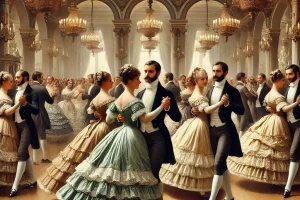
La contradanza fue la primera forma de danza de origen europeo que echó raíces en Cuba y comenzó a transformarse bajo la influencia africana. Es el punto de partida del linaje del baile de salón cubano que eventualmente produciría el danzón, el mambo y el cha-cha-chá.
Lees meer >
La contradanza fue la primera forma de danza de origen europeo que echó raíces en Cuba y comenzó a transformarse bajo la influencia africana. Es el punto de partida del linaje del baile de salón cubano que eventualmente produciría el danzón, el mambo y el cha-cha-chá.
Lees meer >El danzón fue el primer baile nacional de Cuba — la forma que unificó la identidad de la música popular cubana a finales del siglo XIX y principios del XX, y el antepasado del mambo, el cha-cha-chá y, en última instancia, la timba.
Lees meer >El bolero cubano es una de las grandes tradiciones de canción romántica del mundo — lento, íntimo y profundamente emotivo. Es completamente distinto del bolero español (un baile rápido en compás de 3/4) y surgió en Cuba como vehículo para la expresión lírica más sentida de la isla.
Lees meer > Cuba is the largest island in the Caribbean and the birthplace of some of the world's most influential music and dance traditions. African, Spanish, and French cultural streams collided here over centuries of colonial history, producing an extraordinary creative culture that exported itself across the globe.
Lees meer >The Caribbean region was a crossroads of African, European, and indigenous cultures during the colonial era. The movement of enslaved people and colonizers between islands created musical and dance traditions that spread across the region and deeply influenced Cuban culture.
Lees meer > Haiti's influence on Cuban music and dance is direct, historically documented, and still alive in eastern Cuba today. After the Haitian Revolution (1791–1804), a massive migration of French colonists and Afro-Haitian workers reshaped the culture of cuba"> Santiago de Cuba and Guantánamo.
Lees meer > France's influence on Cuban music arrived primarily through the Caribbean colonial world and the Haitian migration. Its impact on Cuban dance history is substantial — the entire lineage from Contradanza to Cha-cha-chá passes through French culture.
Lees meer > Spain colonized Cuba from 1492 to 1898, fundamentally shaping its language, religion, harmonic music traditions, and social structure. Spanish musical culture forms one of the two primary roots — alongside African traditions — of virtually all Cuban music.
Lees meer >
La clave es un patrón rítmico fundamental y principio organizador de la música cubana. Funciona tanto como patrón musical como concepto rector, profundamente arraigado en las tradiciones afrocubanas.
Lees meer >La guitarra española llegó a Cuba con los colonizadores y se convirtió en la semilla de la música cubana, fusionándose con los ritmos africanos. Desde inspirar el tres hasta moldear el son, los conjuntos y hasta la timba moderna, su influencia corre por cada nota de la historia musical cubana.
Lees meer >El piano es el corazón armónico y rítmico de la música popular cubana. En la timba, es uno de los instrumentos más exigentes y expresivos del conjunto.
Lees meer >En la timba (el género cubano que evolucionó del son y la salsa a finales de los años 80 y 90), el violín no es un instrumento central, pero aparece de maneras interesantes:
Lees meer >La trompeta ha sido central en la música popular cubana desde los años 20, cuando se convirtió en la voz melódica principal del septeto de son — la "séptima voz" que transformó el conjunto.
Lees meer >