Orquesta Aragón
Orquesta Aragón is the defining charanga orchestra of the 20th century — an ensemble that maintained the pure charanga sound through every fashion shift and became synonymous with elegant cha-cha-chá and danzón in Cuba and across Latin America.
About
Orquesta Aragón was founded in 1939 in Cienfuegos, the elegant port city on Cuba's southern coast, by bassist Orestes Aragón. The band relocated to Havana in the 1950s, where they would reach their greatest prominence, but their origins outside the capital gave them a slightly different character from the Havana-based ensembles — more refined, perhaps, more focused on pure musical elegance than on the competitive energy of the Havana dance hall scene.
The figure who defined Aragón's sound was flutist Richard Egües, who joined the band in 1953 and remained its musical voice for over fifty years. Egües's flute style — lyrical, precisely ornamented, rhythmically sophisticated without being aggressive — became the tonal signature of the charanga tradition. His compositions and arrangements gave Aragón their repertoire, and his playing gave them their identity.
Aragón came to prominence during the cha-cha-chá era. Where Enrique Jorrín invented the rhythm with Orquesta América, Aragón became one of its most authoritative interpreters — playing cha-cha-chá with the elegance and precision of a classical ensemble while fully inhabiting the genre's playful energy. They also maintained danzón in their repertoire long after most bands had abandoned it as old-fashioned, treating it as the sophisticated dance form it is rather than as a relic.
What makes Aragón historically significant is precisely their consistency. Most Cuban popular orchestras of the 20th century shifted with the market — adapting to mambo, then cha-cha-chá, then songo, then timba. Aragón did not shift. They maintained the charanga instrumentation (flute, violins, piano, bass, timbales, güiro) and the charanga aesthetic throughout, and by doing so became the reference point for what charanga actually sounds like. Any musician who wants to understand the charanga tradition studies Aragón.
Their international reach was particular. In Colombia especially, Orquesta Aragón developed a massive following that persisted for decades — Cuban charanga became embedded in Colombian popular music culture partly through Aragón's recordings and touring. Their influence in Venezuela, Mexico, and across Latin America followed a similar pattern.
Aragón is still performing. Rafael Lay Jr., son of original leader Rafael Lay, has led the band in recent years, maintaining the repertoire and the aesthetic that Richard Egües defined. Their longevity — nearly 90 years of continuous activity — is unmatched in Cuban popular music.
Key Recordings
- "El Bodeguero" — Richard Egües composition, one of the most famous cha-cha-chá recordings
- "Pare Cochero"
- "A Bayamo en Coche"
- Multiple albums on the Panart, EGREM, and RCA Victor labels
Timba is the music this site is dedicated to exploring. It emerged as a distinct genre in the late 1980s and crystallized in the early 1990s — born in a moment of social crisis, built on the full accumulated history of Cuban music, and still evolving today.
Lees meer >Rumba is the most African-rooted of all Cuban music and dance forms — born in the streets, courtyards, and docks of Havana and Matanzas in the late 19th century, with no European instruments, no salon setting, and no pretense of European propriety.
Lees meer >The cha-cha-chá was born from a simple observation: dancers were struggling to follow mambo. Its creator gave them a rhythm they could feel in their feet — and the result became one of the most danced music styles in history.
Lees meer >Songo is the direct bridge between traditional Cuban music and timba. Developed by Los Van Van in the early 1970s, it rewired Cuban popular music by absorbing funk, rock, and jazz into the Afro-Cuban rhythmic foundation — and laid every groundwork that timba would build on.
Lees meer > Cuba is the largest island in the Caribbean and the birthplace of some of the world's most influential music and dance traditions. African, Spanish, and French cultural streams collided here over centuries of colonial history, producing an extraordinary creative culture that exported itself across the globe.
Lees meer > EGREM (Empresa de Grabaciones y Ediciones Musicales) is Cuba's state recording company, founded in 1964 after the Revolution nationalized all private recording labels. Its main facility, Estudios Areíto in Havana, is where virtually every important Cuban recording from the Revolution era was made.
Lees meer >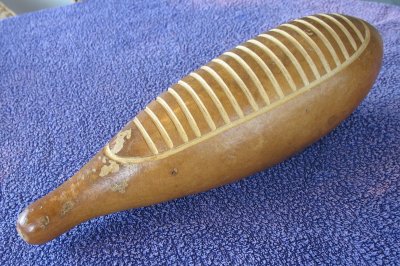
The güiro is a notched gourd scraped with a stick or fork to produce a rasping, rhythmic sound. It is a standard feature of charanga orchestras and is central to danzón, cha-cha-chá, son, and salsa.
Lees meer >The timbales ( pailas criollas) are a pair of shallow, metal-shell drums mounted on a stand, played with wooden sticks. They are the rhythmic engine of charanga orchestras and play a critical role in timba.
Lees meer >The piano is the harmonic and rhythmic heart of Cuban popular music. In timba, it is one of the most demanding and expressive instruments in the ensemble.
Lees meer > Timba, the explosive and rhythmically rich genre of Cuban dance music, transformed how the bass functions in popular music. In Timba, the bass is not just foundational — it’s fiery, funky, and free.
Lees meer >A Cuban popular dance music genre that emerged in the 1980s–90s
- emerged in the 1980s–90s
- influenced by songo, rumba, funk, blues, jazz, pop, rock and Afro-Cuban rhythms.
- Known for complex rhythm shifts, aggressive bass lines, and high energy that push dancers to improvise.
Lees meer >Mambo
In Cuban music, especially in salsa and son,
the "mambo" section typically refers to a brassy, rhythmically intense instrumental break,
often featuring repetitive horn lines, call-and-response patterns, and building energy toward the climax of a song.
The Casa de la Trova in Santiago de Cuba is the spiritual home of Cuban traditional music — Son, Bolero, Changüí, and Trova. Founded in 1968 on Calle Heredia in the heart of Santiago's historic center, it has been the gathering place for the city's musicians for over half a century.
Lees meer >